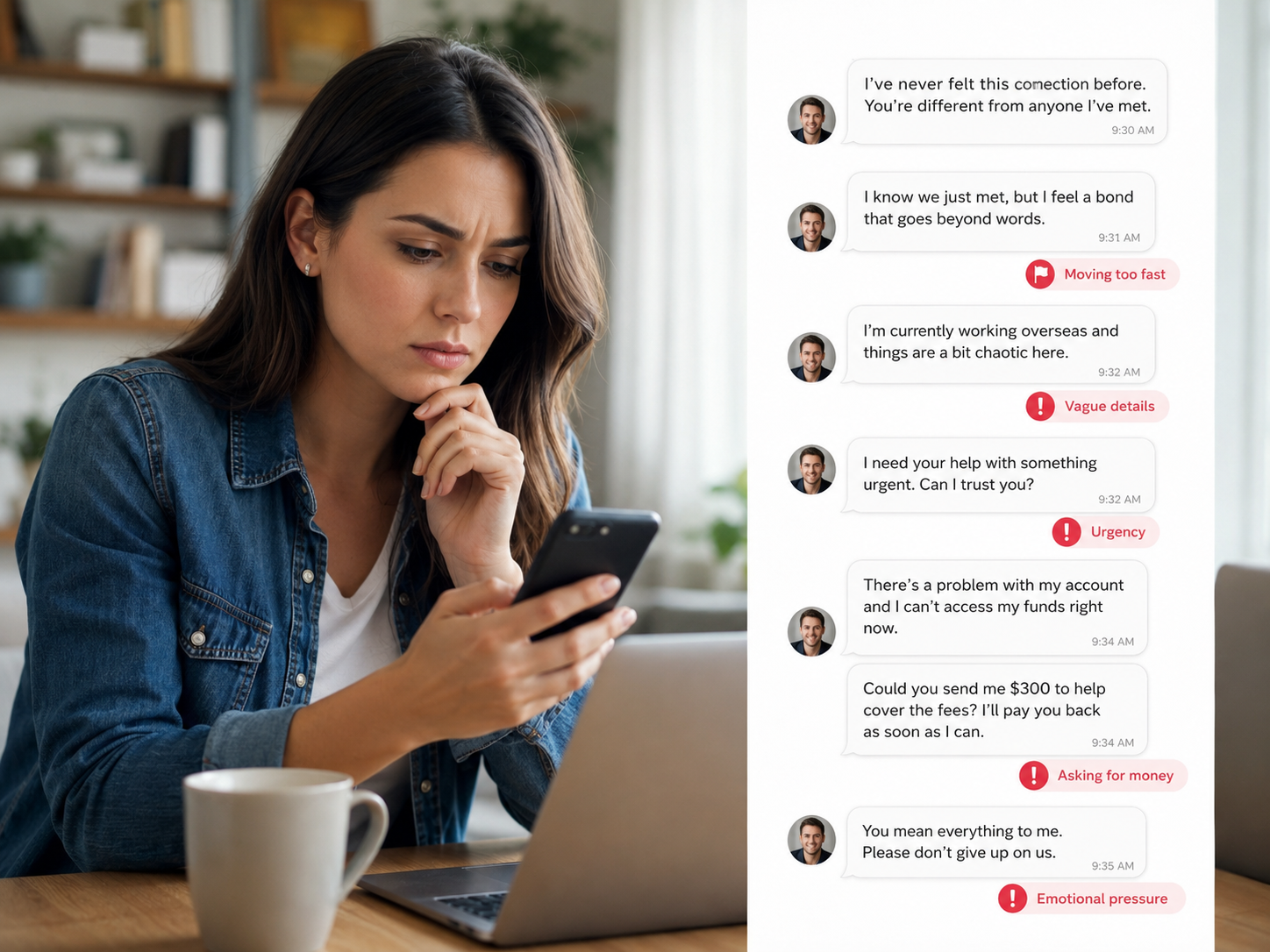
Romance scams rarely begin with an obvious demand for money. They usually begin with attention, frequent messages, and a person who seems unusually interested in your life. The financial request comes later, after trust and emotional dependence have been built.
The essential rule
Do not send money, cryptocurrency, gift cards, financial account access, or valuable items to a romantic interest you have only met online. A sad or urgent story does not make an unverified payment safer.
Romance fraud can affect people of any age, gender, income, or background. Being targeted is not the victim’s fault. Scammers deliberately exploit trust, loneliness, hope, and the natural desire to help somebody we care about.
IN THIS GUIDE
What is a romance scam?
A romance scam happens when a criminal creates or uses a false identity to build an apparently close relationship and exploit the other person. The scammer may spend weeks or months developing trust before asking for money, encouraging an investment, requesting intimate material, or involving the victim in financial transactions.
One warning sign alone does not prove somebody is a criminal. The concern becomes much stronger when several signs appear together—especially secrecy, avoidance of verification, and any request involving money.
11 romance scam red flags
1. They declare intense feelings unusually quickly
A scammer may describe the connection as destiny, use pet names immediately, or talk about marriage before you have had time to know each other. Fast emotional intensity can make normal caution feel disloyal.
A genuine person may also become enthusiastic quickly. The important question is whether they respect your wish to slow down and verify the relationship.
2. Their personality seems perfectly matched to yours
Fraudsters can use information from social media to mirror your values, interests, faith, experiences, or hopes. A profile that appears almost impossibly compatible deserves patient checking rather than instant trust.
3. They repeatedly avoid live video or meeting in person
Common explanations include military deployment, offshore work, an overseas construction project, poor internet, a broken camera, family emergencies, or last-minute travel problems. Any individual excuse may be genuine. A continuing pattern of excuses is the warning sign.
Modern AI can make images, audio, and video more convincing, so a single short video call is not complete proof. It is still useful when combined with other checks and natural, unscripted conversation.
4. They rush you away from the dating platform
Moving to text, WhatsApp, Telegram, or email is normal in many genuine relationships. The risk is greater when somebody insists on leaving the platform almost immediately, discourages you from reporting them, or says the account will soon disappear.
The FBI has also warned about fake dating “verification” services that collect payment details or enroll people in recurring subscriptions. Do not use a verification link supplied by a new match.
5. Their story contains inconsistencies
Names, ages, locations, jobs, family details, or timelines may change. Photographs may appear under another name, or basic claims may conflict with information that can be checked independently.
Small memory errors happen to everybody. Repeated contradictions about basic facts are different—especially when reasonable questions produce anger, guilt, or another dramatic distraction.
6. They encourage secrecy or isolate you from other people
A fraudster may say friends and family are jealous, prejudiced, or incapable of understanding the relationship. They may ask you not to discuss their financial situation or tell you that sharing concerns would betray their trust.
Healthy relationships can tolerate outside perspective. Secrecy gives a scammer more control and removes the second opinion that might expose the story.
7. An emergency suddenly requires your money
The request may involve hospital treatment, plane tickets, visa costs, customs charges, a frozen bank account, a business crisis, a child’s needs, or a problem preventing an expected visit. The story is usually designed to make delay feel cruel.
The Federal Trade Commission advises people not to send money to an online love interest, regardless of how convincing the story appears.
8. They tell you to use a difficult-to-reverse payment method
Gift card numbers, cryptocurrency, wire transfers, payment apps, and cash transfers are attractive to criminals because recovery can be difficult. A request to split payments, misdescribe their purpose, or keep the transaction secret is especially concerning.
9. Romance turns into an investment opportunity
Some scams combine emotional manipulation with fake cryptocurrency or investment platforms. The person may show apparent profits, claim to have a secret strategy, or introduce a supposedly knowledgeable relative. Early withdrawals may even be allowed to build confidence before larger sums are trapped.
Never invest through a platform chosen by an online romantic interest. Check financial firms independently and do not use links or contact details supplied by the person.
10. They want to use your bank account or receive items through you
A person may ask to deposit money into your account, route a transfer through you, receive a package at your address, or buy items on their behalf. This could involve stolen funds, money laundering, or other fraud.
Do not move money for another person or allow them access to your account. Contact your bank immediately if this has already happened.
11. They request intimate images or sensitive personal information
Identity documents, passwords, security codes, banking information, national identification numbers, and intimate images can be used for theft, account takeover, or blackmail. A person who respects you will not pressure you to provide material that makes you vulnerable.
Three questions to ask yourself
- Can their identity and story be checked through more than one independent method?
- Do they respect boundaries when I slow the relationship down?
- Would I make this financial decision without the emotional relationship?
How to check an online relationship safely
- Keep early conversations on the dating platform.
- Use live, unscripted video calls at different times.
- Reverse-search profile photographs.
- Check whether names, jobs, locations, and timelines remain consistent.
- Search distinctive parts of their story alongside terms such as “scam.”
- Discuss the relationship with somebody you trust.
- Never treat a verified badge as proof that every claim is true.
Read the full AmaraDate guide to verifying someone you met online without invading their privacy.
What to do if you suspect a romance scam
- Stop sending money or information. Do not make one final payment to release funds, arrange a visit, or prove trust.
- Pause contact. Preserving your safety and evidence matters more than winning an admission.
- Talk to somebody you trust. Emotional distance can make the pattern easier to see.
- Save evidence. Keep usernames, profile links, messages, email addresses, phone numbers, wallet addresses, and payment records.
- Report the account. Notify the dating app, social platform, or messaging service.
- Secure your accounts. Change reused passwords, enable two-factor authentication, and review active sessions.
If you have already sent money
Contact your bank, card issuer, cryptocurrency exchange, payment app, or transfer company immediately. Explain that the payment was induced by fraud and ask whether it can be stopped, recalled, or investigated. Speed can matter, although recovery is not guaranteed.
- Contact your bank, card provider, payment app, transfer service, or cryptocurrency exchange immediately.
- Report the account to the dating platform or social network.
- Use the official fraud-reporting or cybercrime service in your country.
- In the United States, reports can be made to the Federal Trade Commission and the FBI Internet Crime Complaint Center.
- Contact local police when appropriate and call your local emergency number if anybody is in immediate danger.
Be alert to recovery scams. Criminals may return pretending to be investigators, lawyers, hackers, or specialists who can retrieve the money for an upfront fee. The FBI warns that IC3 does not demand money to recover funds.
For a more detailed decision guide, read Should You Ever Send Money to an Online Love Interest?
Frequently asked questions
Does refusing a video call prove somebody is a scammer?
No. There may be genuine reasons for delaying a call. Repeated avoidance, changing excuses, and requests for money together create a much stronger concern.
Can a verified dating profile still be fraudulent?
Yes. Verification features differ between platforms and may confirm only a photograph, phone number, or document at one point in time. Treat verification as one signal, not a guarantee.
Is it safe to send a small amount first?
A small request may be used to test whether you will pay. Paying once can lead to larger and more frequent demands. The safe rule is not to send money to somebody you know only online.
Official sources and further help
- Federal Trade Commission: Why can’t that new love interest meet in person?
- Federal Trade Commission: Romance scams
- FBI Internet Crime Complaint Center
- FBI: Fake dating verification schemes
Reporting routes vary by country. Use official government, police, cybercrime, or consumer-protection services rather than contact details supplied by the suspected scammer. Call your local emergency number if anybody is in immediate danger.
Last reviewed: July 2026. This article provides general safety information and is not legal, financial, or emergency advice.