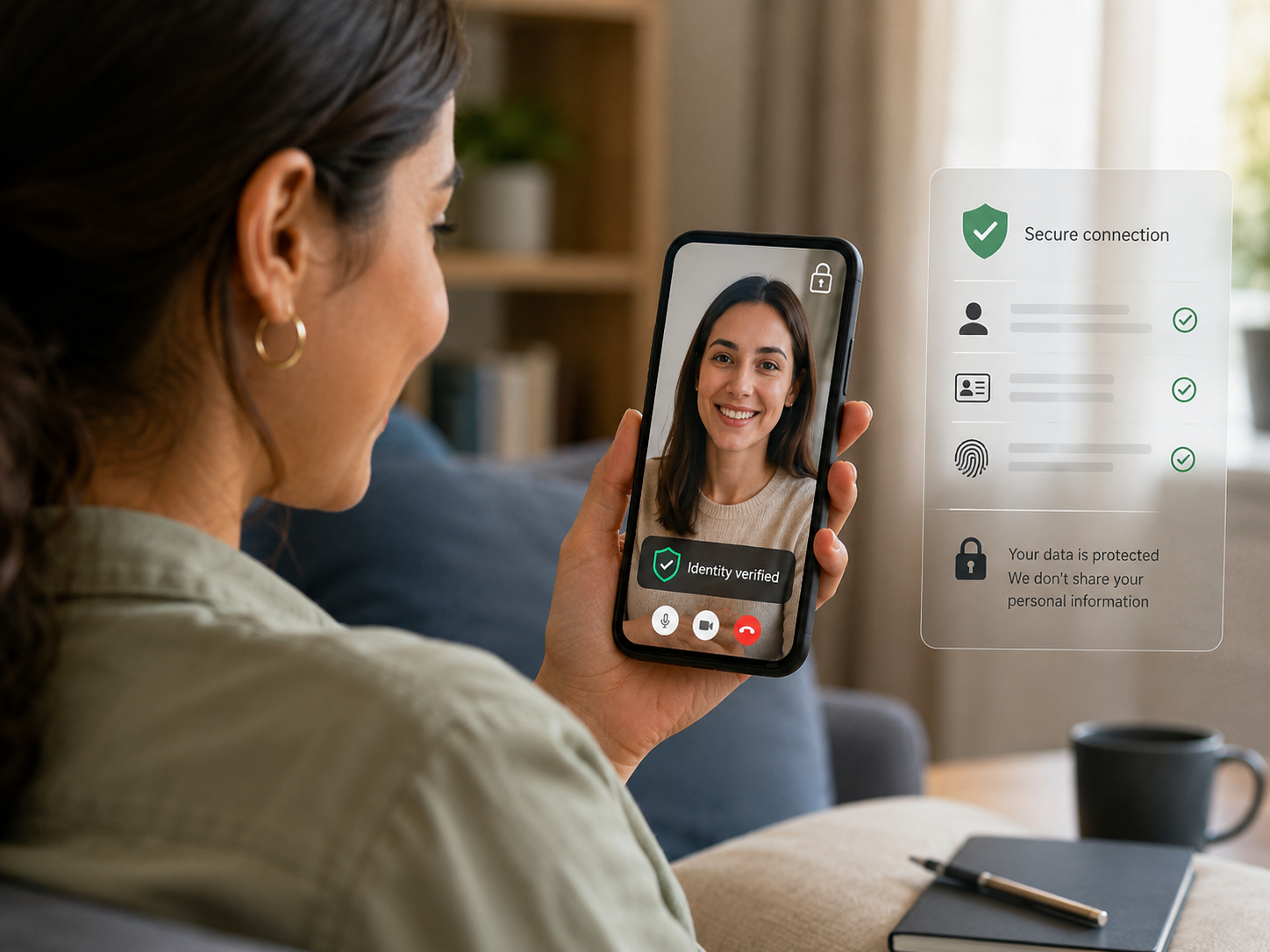
Verifying an online dating contact does not mean demanding private documents, secretly tracking them, or treating every new person as a criminal. It means giving trust time to develop and checking important claims through several reasonable, independent methods.
What verification can—and cannot—tell you
Verification can increase confidence that a person, photograph, and basic life story are connected. It cannot prove that somebody is kind, faithful, financially honest, or safe in every situation. Identity is only one part of trust.
The safest approach is cumulative. A live video call, consistent information, an established profile, and a safe public meeting are more useful together than any one check in isolation. Be particularly cautious when somebody resists every reasonable check while asking for secrecy, money, or rapid commitment.
A privacy-respecting verification checklist
1. Keep early conversations on the dating platform
Dating services can retain reports, account information, and conversation records that may help when something goes wrong. Moving to private messaging is not automatically suspicious, but there is rarely a good reason to be rushed away from the platform immediately.
Do not click unfamiliar login, payment, or “verification” links sent in chat. The FBI has warned about fake dating verification websites that collect personal and payment information or enroll people in recurring subscriptions. Open the dating service through its official app or website instead.
2. Look for a consistent story over time
Pay attention to basic facts such as age, location, work, family circumstances, travel, and daily routines. Genuine people can forget small details or explain something badly. Concern is more appropriate when central facts repeatedly change or sensible questions trigger manipulation.
3. Arrange natural, live video calls
A live call allows you to compare the person with their photographs and see whether conversation feels spontaneous. Suggest calls at different times rather than relying on one short, highly controlled interaction.
Modern AI can generate or alter convincing media, so video is useful but not conclusive. Repeated technical excuses become more significant when combined with contradictory details, financial requests, or pressure to keep the relationship secret.
4. Reverse-search profile photographs
Use a reputable reverse-image-search service to check whether a profile photograph appears elsewhere under another name or in an unrelated context. Try more than one image, including photographs that are not heavily filtered.
A matching image does not always prove fraud. People reuse photographs across accounts, and public figures or professionals may have images copied without permission. Treat mismatched names or life stories as a reason for further checking.
5. Search distinctive parts of their story
The Federal Trade Commission recommends searching the person’s claimed type of job plus the word “scammer.” You can also search an unusual sentence from a message in quotation marks. Identical wording across scam reports or multiple profiles can be informative, although user-generated claims should not be treated as definitive proof by themselves.
6. Check whether the wider online presence makes sense
An older account with varied interactions can be more reassuring than a new profile containing only polished photographs. Look for ordinary signs of a real life: changing interests, genuine conversations, and a timeline that broadly matches the story you have been told.
Follower numbers, verification symbols, and professional-looking pages can be purchased, stolen, or manipulated. An established account is a signal, not proof.
7. Understand what platform verification actually means
Some dating apps compare a live selfie with profile photographs. Others verify a phone number, email address, or identity document. Read the platform’s explanation instead of assuming every badge represents a full background check.
A genuine verification can still be attached to a person who lies about intentions, relationship status, employment, or finances.
8. Ask for ordinary confirmation, not sensitive documents
Do not exchange passport scans, driver’s licenses, Social Security numbers, banking screenshots, workplace security cards, or full home addresses as proof of trust. Documents can be stolen, altered, or later misused.
Reasonable confirmation might include a live call, a consistent public professional profile, or an eventual public meeting. The goal is not to collect enough information to impersonate each other.
9. Discuss the relationship with somebody you trust
Emotional involvement can make contradictions easier to explain away. A friend or relative may notice urgency, secrecy, or financial pressure that feels normal from inside the relationship.
10. Meet safely when you are ready
- Choose a busy public venue.
- Tell a trusted person where you will be and when you expect to return.
- Arrange your own transportation and accommodation.
- Keep control of your passport, phone, money, medication, and return ticket.
- Do not feel obligated to extend the date or move to a private location.
- Call the local emergency number if you are in immediate danger.
What not to do when verifying somebody
- Do not install tracking software or attempt to access their accounts.
- Do not publish accusations, private information, or intimate material.
- Do not pay an unregulated “investigator” who promises certainty.
- Do not send your own identity documents as part of a proof exchange.
- Do not transfer a small amount of money as an identity test.
Verification should protect both people’s privacy and safety. Covert surveillance, doxxing, and unauthorized account access can be harmful and potentially unlawful.
When should you stop communicating?
Consider ending contact when the person repeatedly refuses reasonable verification, changes central facts, becomes abusive when questioned, pressures you to keep secrets, asks for money, or tries to involve you in investments or financial transfers.
You are allowed to end an online relationship without proving beyond doubt that it is fraudulent. Review the complete list of romance scam red flags before making financial or travel commitments.
Verification before international travel
International relationships can involve genuine practical barriers, but travel should not be used to bypass unanswered questions. Before traveling to meet somebody for the first time:
- Have several natural video calls.
- Confirm meeting arrangements independently.
- Book your own transportation and accommodation.
- Keep emergency funds and a return plan under your control.
- Share your itinerary with somebody at home.
- Check current travel advice, entry requirements, and local laws through your own government’s official travel service.
- Do not carry money, packages, documents, or medication for the other person.
Read relevant AmaraDate country guides for cultural context, while remembering that nationality does not prove identity or intentions.
What to do when verification raises concerns
Stop sending money or sensitive information, save evidence, report the profile to the platform, and secure your accounts. Use the official fraud-reporting or cybercrime service in your country. In the United States, reports can be made to the FTC and the FBI Internet Crime Complaint Center. Contact local police or your local emergency service when there is an immediate safety threat.
Before any request involving money, also read Should You Ever Send Money to an Online Love Interest?
Frequently asked questions
Can someone fake a live video call?
AI and edited media can make video less conclusive than it once was. Natural calls at different times, consistent conversation, and an eventual safe public meeting provide stronger reassurance together.
Should I ask to see their passport?
No. A passport image can be stolen or altered and contains sensitive information. Use proportionate checks and the platform’s official verification system where available.
Does a reverse-image match always mean fraud?
No. The photograph may have been copied from the genuine person or legitimately reused. A different name or biography is a serious inconsistency that requires further checking.
What if they say verification shows I do not trust them?
Reasonable safety boundaries are not an insult. A healthy prospective partner should understand why both people need to protect themselves online.
Official sources and further reading
- Federal Trade Commission: Why can’t that new love interest meet in person?
- FBI: New verification schemes target dating app users
- U.S. State Department travel advisories
- FBI Internet Crime Complaint Center
The sources above provide useful examples of official guidance. Readers should also use the travel, fraud-reporting, police, and emergency services provided by their own country.
Last reviewed: July 2026. This article provides general safety information and is not legal, investigative, or emergency advice.