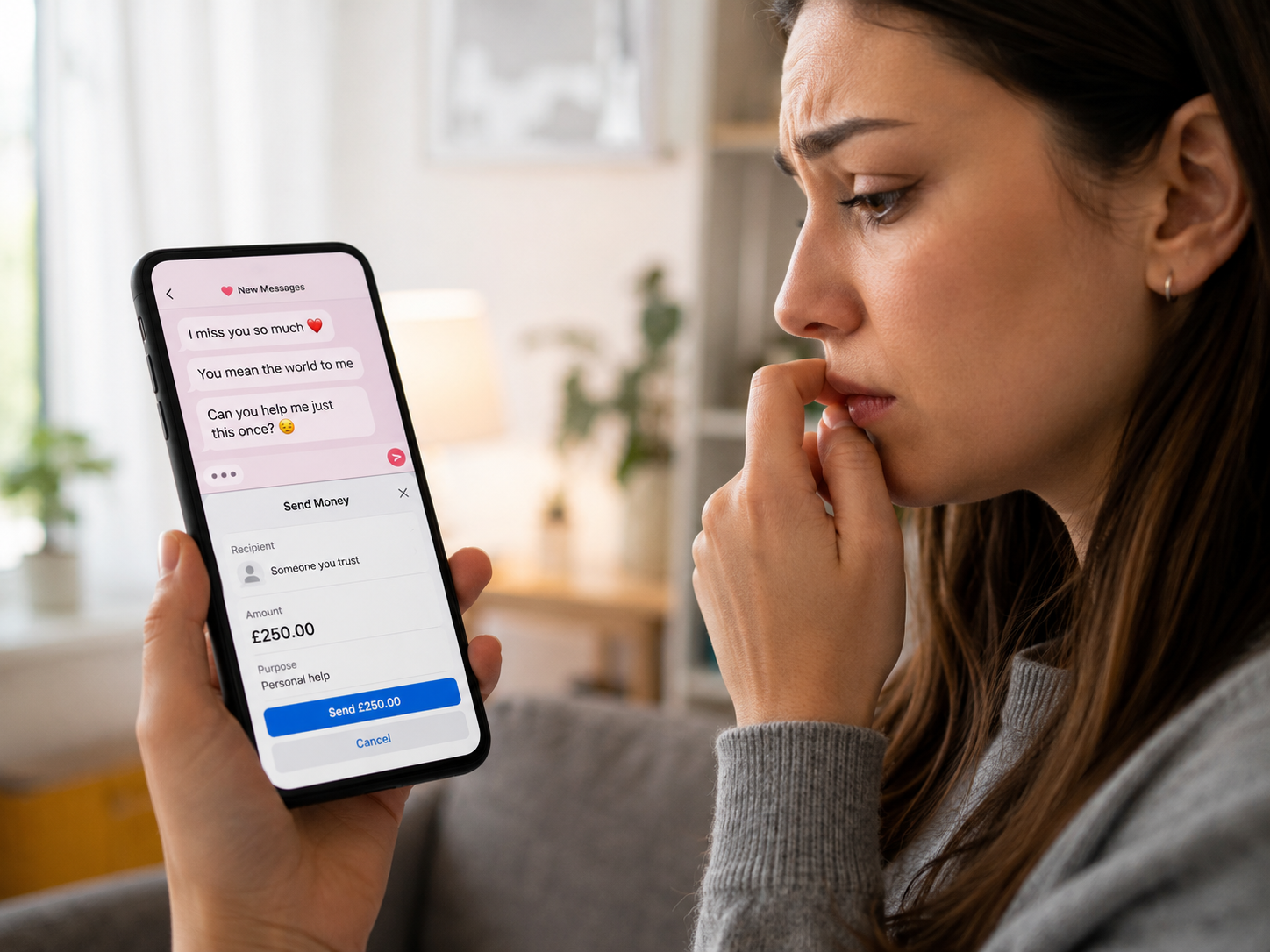
The safest answer is no: do not send money, cryptocurrency, gift cards, account access, or valuable items to a romantic interest you have only met online.
This rule can feel harsh when the relationship seems emotionally real. That emotional reality is exactly what romance fraud exploits. A request may arrive only after months of daily contact, affectionate messages, and plans for a future together.
A genuine emergency does not make an unverified payment safe
You do not need to prove that a story is false before refusing to pay. You are allowed to protect your finances while offering non-financial emotional support.
Why online romantic requests are unusually risky
A person you have not met can control almost everything you see: photographs, messages, documents, phone numbers, video clips, and the apparent reactions of friends or relatives. Criminal groups may maintain detailed scripts and work together to make the situation feel authentic.
The Federal Trade Commission tells consumers not to send cash, gift cards, wire transfers, payment-app transfers, or cryptocurrency to an online love interest. The FBI likewise advises people never to send money or invest based on the advice of somebody they have solely met online.
Common reasons scammers give for needing money
Travel, passport, and visa costs
The person promises to visit you but suddenly needs help with a flight, visa, airport fee, hotel, passport problem, or missed connection. Each payment may produce another obstacle.
Medical or family emergencies
A hospital bill, sick child, injured parent, or urgent treatment creates powerful emotional pressure. Documents, photographs, and phone calls can be fabricated or taken from a real unrelated event.
A frozen account or delayed paycheck
They claim to be temporarily unable to access their own money and promise immediate repayment. A person who repeatedly has substantial resources but no safe way to use them is presenting a contradiction worth examining.
Customs, packages, and valuable property
You may be told that cash, jewelry, business goods, or personal belongings are being held until a fee is paid. Messages from the supposed courier, attorney, or customs agent may be part of the same fraud.
Business opportunities
A contract, construction project, inheritance, or property deal supposedly needs short-term funding. The promised return is used to make the payment seem practical rather than romantic.
Cryptocurrency or investment guidance
The person claims to have expert knowledge, a successful relative, or access to a special platform. The website may display profits that do not exist. Requests for taxes, release fees, or verification payments often follow when you try to withdraw.
Phones, subscriptions, and gift cards
Small early requests can test whether you will pay. Once a payment has been normalized, the amount and urgency may increase.
Payment methods that should increase your concern
- Gift cards: the person asks for the numbers or photographs from the back of a card.
- Cryptocurrency: they provide a wallet address or guide you through buying and transferring coins.
- Wire or cash transfer: they use services designed for rapid movement of money.
- Payment apps: they pressure you to label the transfer as being to a friend or family member.
- Bank transfer: they ask you to use an unfamiliar personal or business account, sometimes in another name or country.
- Package forwarding: they ask you to receive and resend goods bought with unknown funds.
No payment method becomes safe simply because the amount is small or the recipient appears to have identification.
What if you have met them on video?
A video call is useful, but it does not prove the person’s full story or intentions. Real people can participate in fraud, stolen identities can be supported by accomplices, and AI can alter media.
Use several checks before trust, travel, or money become involved. Follow the AmaraDate guide to verifying somebody you met online.
What if you have met them in person?
Meeting in person reduces some identity uncertainty, but it does not remove the possibility of manipulation, coercive control, investment fraud, or financial abuse. Avoid lending money you cannot afford to lose, becoming a co-signer, sharing account access, or investing through a partner’s chosen platform.
Before combining finances in a genuine established relationship, consider independent legal or financial advice and transparent conversations about income, debt, repayment, and responsibility.
A five-step decision test
- Stop. Do not pay while emotional pressure is high.
- Separate the story from the relationship. Would you accept the same request from an online stranger?
- Verify independently. Do not use contact details, documents, or websites supplied by the person.
- Ask somebody you trust. Tell them the complete story, including secrecy or previous payments.
- Decline the payment. Notice whether the person respects the boundary or responds with anger, threats, guilt, or a larger emergency.
Read 11 Romance Scam Red Flags You Should Never Ignore when the request forms part of a wider pattern.
“Can I pay the hospital, airline, or company directly?”
Direct payment can still be unsafe. The phone number, website, invoice, or recipient may be controlled by the same criminals. Even a genuine company payment does not prove the relationship story.
Find the organization’s official contact details independently. Do not click a supplied link or rely on an incoming call. You can still refuse to pay after confirming that an organization exists.
If you have already sent money
- Stop further payments, including “release,” “tax,” “recovery,” or “verification” fees.
- Contact your bank, card issuer, transfer company, payment app, or cryptocurrency exchange immediately.
- Explain that you believe the payment was induced by fraud and ask whether it can be stopped or recalled.
- Save messages, profile links, phone numbers, email addresses, wallet addresses, and transaction records.
- Report the account to the dating or social platform.
- Change compromised passwords and review your email, banking, and social media security.
- Consider a fraud alert or credit freeze if identity information was shared.
Use the official fraud-reporting or cybercrime service in your country. In the United States, reports can be made to the Federal Trade Commission and the FBI Internet Crime Complaint Center. Contact local police when appropriate, and call your local emergency number if somebody is in immediate danger.
Do not blame yourself
Romance fraud is designed to exploit trust, hope, and emotional connection. It is not a sign that a victim is foolish. Shame can delay reporting and leave somebody isolated, while early contact with a bank or reporting service may reduce further harm.
Be alert to people claiming they can recover lost money for an upfront fee. The FBI warns that IC3 does not work with private recovery companies and will not demand money from victims.
Frequently asked questions
Is it safe to lend a small amount?
A small request can test whether you are willing to pay and can lead to larger demands. Do not send money to a romantic interest you know only online.
What if they promise to repay me tomorrow?
A repayment promise does not verify identity or access to funds. Scammers often explain why repayment has been delayed and request another payment to solve the new obstacle.
Can I accept money from them instead?
Do not allow an online contact to use your account, ask you to forward funds, or receive goods on their behalf. You could become involved in moving stolen money or property.
Does this rule apply to genuine long-distance relationships?
The strictest rule applies while the person and circumstances remain unverified and the relationship exists only online. Established couples may eventually make shared financial decisions, but those decisions still require transparency, independent verification, and normal financial caution.
Official sources and further help
- Federal Trade Commission: Romance scams
- Federal Trade Commission: Signs of an online romance scam
- FBI Internet Crime Complaint Center
- FBI: Cryptocurrency investment scams using romantic relationships
The sources above provide useful examples of official guidance. Readers should also contact their financial provider and use the official fraud-reporting, police, and emergency services available in their own country.
Last reviewed: July 2026. This article provides general safety information and is not individual financial, legal, or emergency advice.